Research in depth
How does the brain compute strategic decisions?
My research seeks to understand how neural circuits compute strategic decisions, integrating naturalistic behavior, large-scale neural recordings, and computational modeling to build a circuit-level account of how the brain generates prosocial choices. My training spans two complementary model systems, giving me a principled framework that links behavior, computation, and circuit mechanisms across both individual and social contexts.
PhD work · Washington University in St. Louis
Causal function of orbitofrontal cortex in economic decision-making
A foundational question in decision neuroscience is whether neural activity in a region merely correlates with behavior, or actually drives it. Working with Dr. Camillo Padoa-Schioppa, we used microstimulation at varying current levels to show that OFC activity causally shapes economic choices: low currents facilitated value encoding and biased choices, while high currents disrupted value representations. Strikingly, even very low currents altered choices specifically at the value comparison stage rather than the valuation stage, revealing dissociable computational processes within OFC.
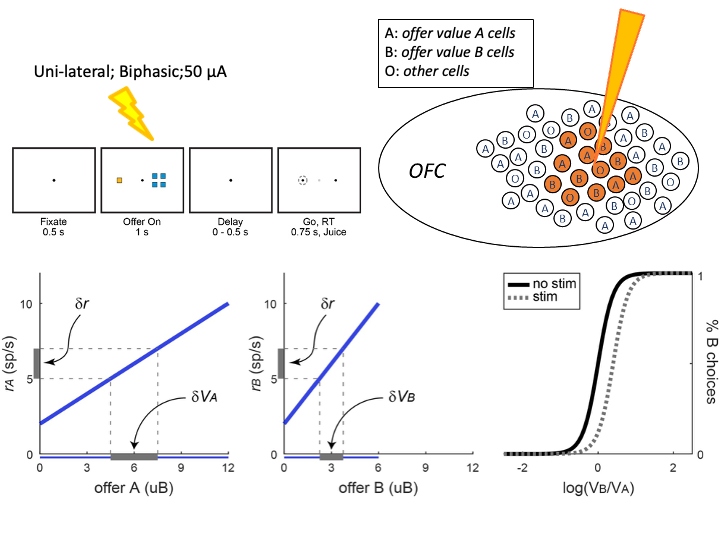
Microstimulation of OFC causally biases economic choices.
We further showed that the same OFC circuit supports decisions whether offers are presented simultaneously or sequentially, and dissected three distinct sources of decision variability under sequential offers — decision noise, order bias, and preference bias — each mapping onto a distinct neural process. Together, this work established a mechanistic, causal account of how OFC computes economic choices.
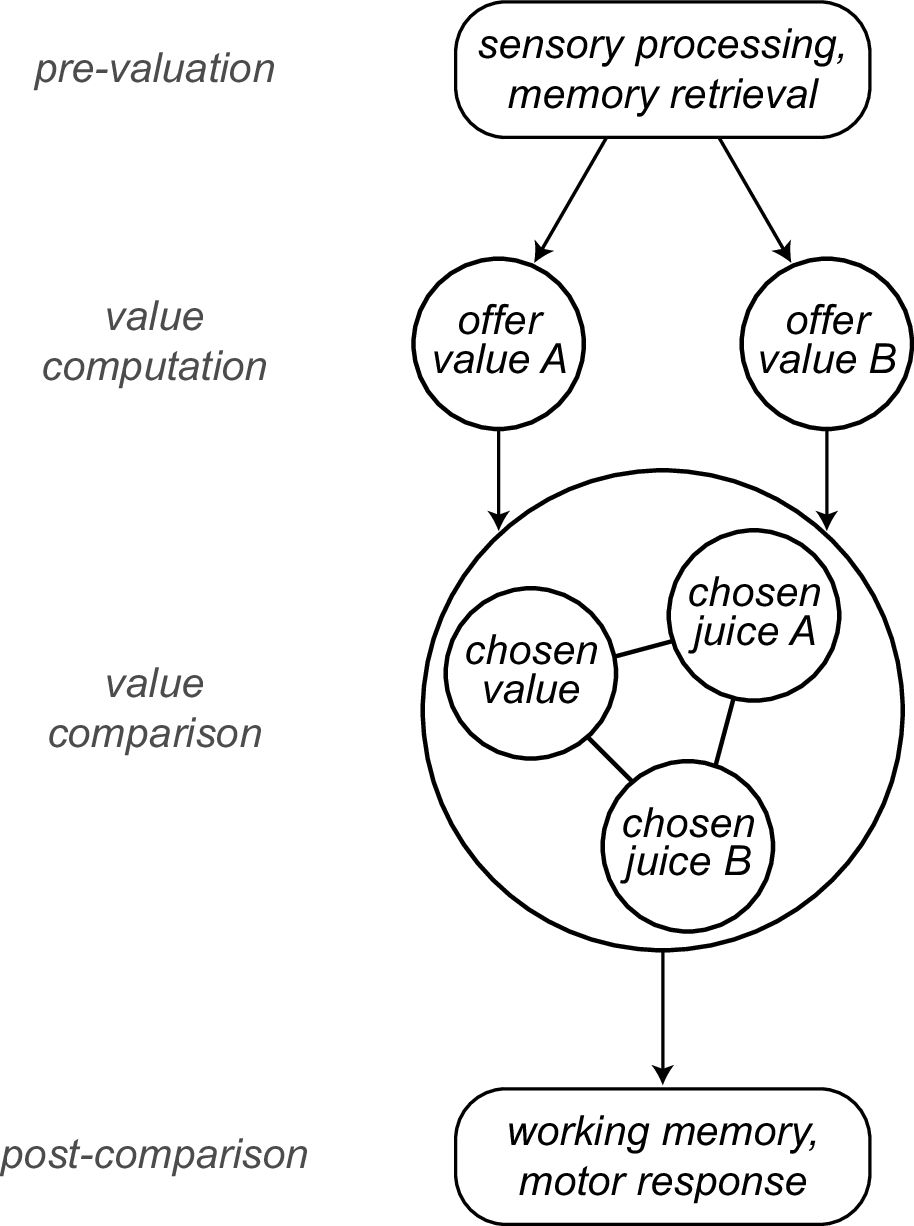
The OFC decision circuit underlying value computation and comparison.
Ballesta*, Shi* et al. Values encoded in orbitofrontal cortex are causally related to economic choices. Nature, 588 (2020)
Ballesta, Shi, Padoa-Schioppa. Orbitofrontal cortex contributes to the comparison of values underlying economic choices. Nature Communications, 13 (2022)
Shi et al. Economic choices with simultaneous or sequential offers rely on the same neural circuit. Journal of Neuroscience, 42 (2022)
Shi et al. Neuronal origins of reduced accuracy and biases in economic choices under sequential offers. eLife, 11 (2022)
Postdoctoral work · Yale University
Neural mechanisms of cooperative social decisions in freely moving animals
As a Wu Tsai Postdoctoral Fellow and NIMH T32 fellow with Drs. Steve Chang, Anirvan Nandy, and Monika Jadi, I extended my decision neuroscience framework to cooperative social behavior. Most social neuroscience paradigms are artificial and constrained. To address this, I co-developed an integrated platform combining a naturalistic cooperative task, markerless behavioral tracking, and custom wireless high-density neural recordings, enabling simultaneous measurement of behavior and neural activity in freely interacting dyads.
Using this platform, we found that dyads develop diverse and flexible behavioral repertoires rather than converging on a fixed strategy, and that this flexibility predicts cooperative success. Dynamic Bayesian Network analysis revealed two distinct classes of cooperative strategy: gaze-dependent coordination, where animals actively monitor their partner before acting, and gaze-independent rhythm-based coordination.
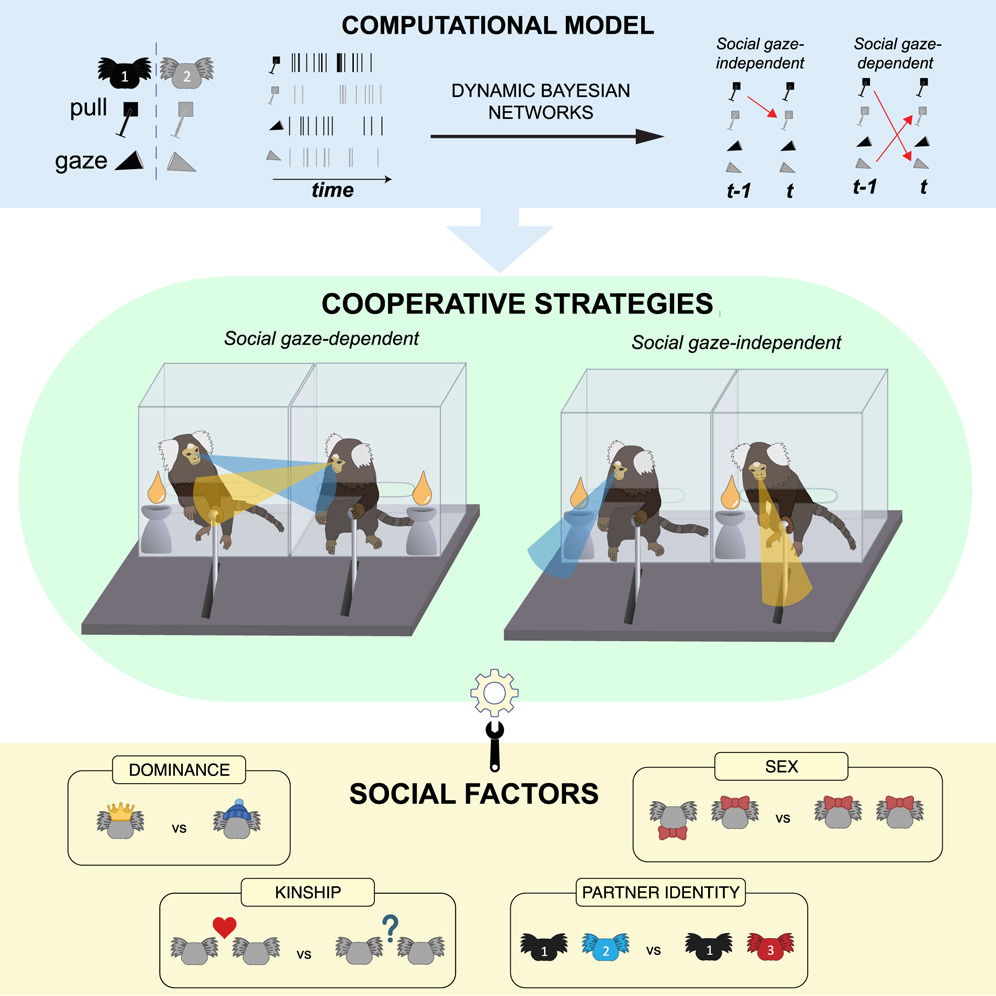
Diverse cooperative strategies identified using Dynamic Bayesian Networks.
Social gaze played a central role in cooperative decisions. Applying a drift-diffusion model, we showed that gaze gates evidence accumulation in the dorsomedial prefrontal cortex, with neural population dynamics tracking the accumulation process in real time and establishing dmPFC as a key node for social evidence integration during naturalistic cooperation.
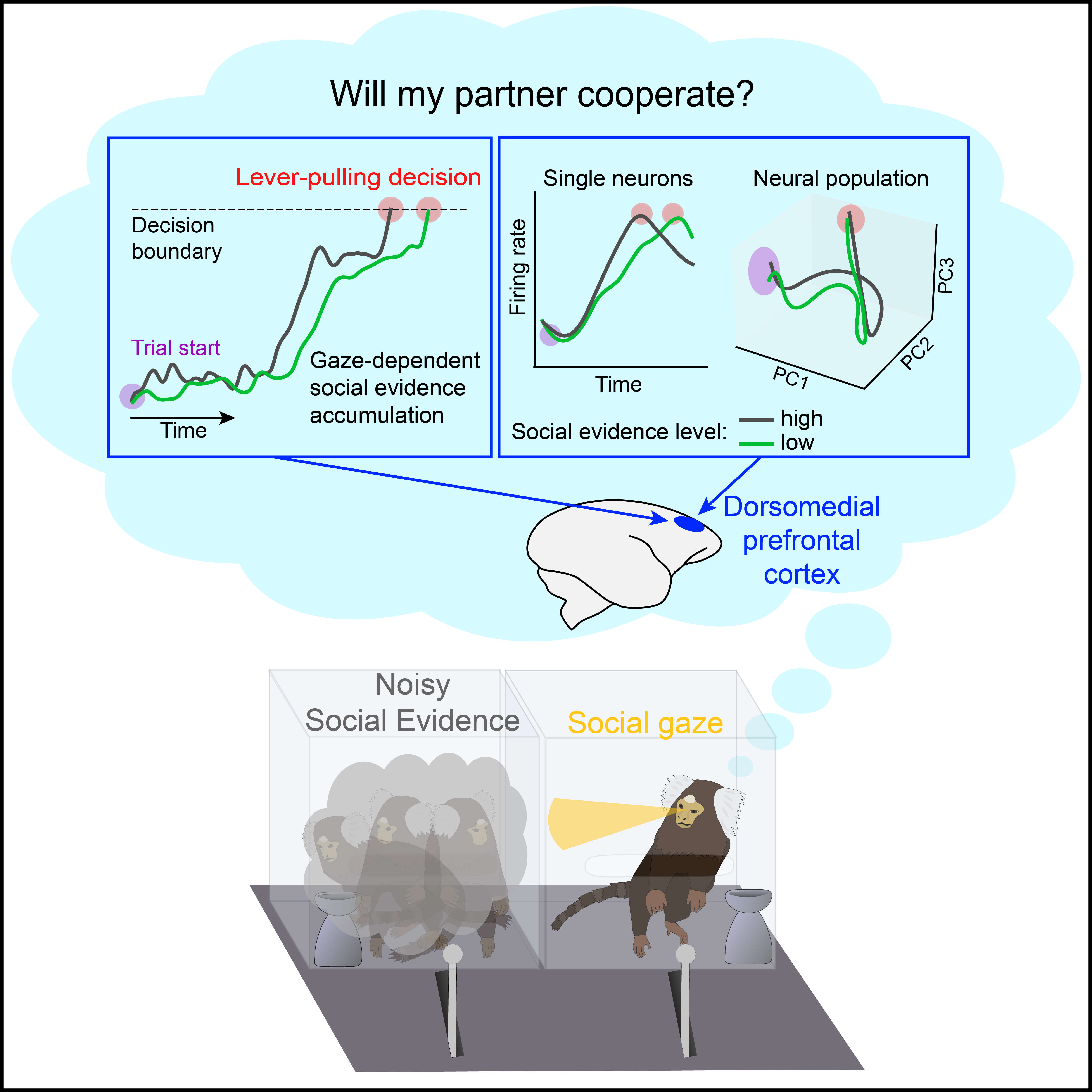
Gaze-dependent social evidence accumulation in dorsomedial prefrontal cortex.
Shi et al. Canonical decision computations underlie behavioral and neural signatures of cooperation in primates. Neuron, 114, 2657–2667.e5 (2026) — selected as the issue's cover article; previewed in Stuphorn, V., "Decide when to cooperate," Neuron, 114 (2026)
Meisner*, Shi* et al. Diverse and flexible strategies enable successful cooperation in marmoset dyads. Current Biology, 35 (2025) — featured in Dispatches: Miller, C.T., "Animal cognition: Adaptive cooperation strategies in marmoset monkeys," Current Biology, 35 (2025)
Meisner, Shi et al. Development of an apparatus for automated pulling to study cooperative behaviors. eLife, 13 (2024)
Shi et al. The orbitofrontal cortex: a goal-directed cognitive map framework for social and non-social behaviors. Neurobiology of Learning and Memory, 203 (2023)
Future directions · Independent research program
Cortico-striatal circuit mechanisms of strategic social decisions
My planned research program will build a mechanistic understanding of how the brain computes strategic social decisions — decisions that require weighing one's own interests against a partner's. Effort inequity, where self and partner face different levels of effort cost, serves as a tractable entry point into this broader question, isolating the core conflict between self-cost and mutual benefit in a form I can manipulate and quantify. The central hypothesis is that communication between the dorsomedial prefrontal cortex and the dorsal striatum implements the computations that guide these strategic choices. The near-term work combines data-driven behavioral modeling, to discover the repertoire of cooperative strategies animals develop under effort inequity and their neural correlates in dmPFC, with computational models of the underlying decision process, linking model parameters directly to neural population dynamics.
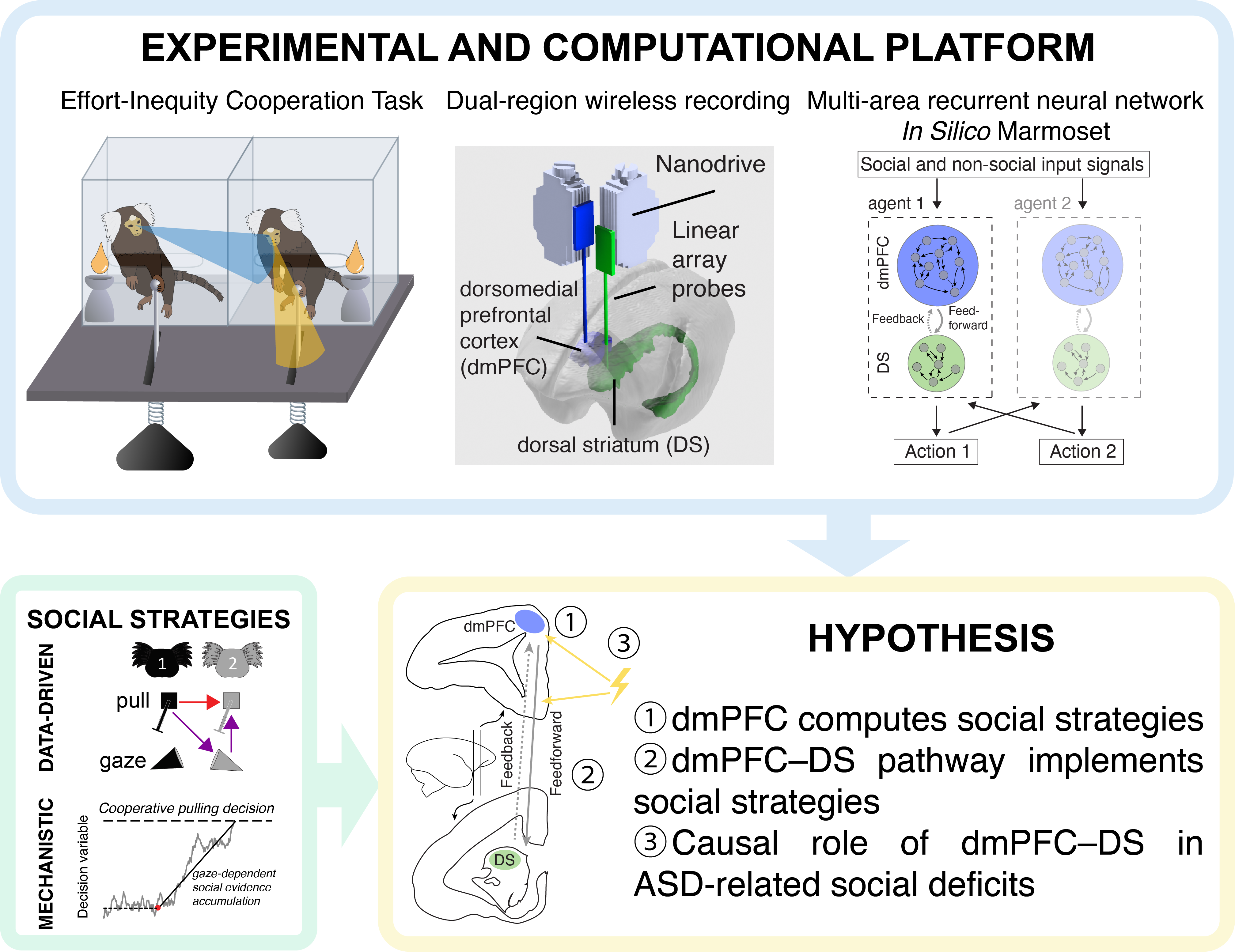
Planned research program: from cooperative behavior to cortico-striatal circuit mechanisms.
This work will expand to simultaneous wireless recordings from dmPFC and dorsal striatum, testing whether dmPFC encodes high-level strategic variables while the striatum translates these into action policies. Computational models, developed in collaboration with computational neuroscientists, will help formalize how this circuit gives rise to strategic choice, generating predictions I will test with targeted causal manipulations of the dmPFC-striatal pathway.
In the longer term, this causal, circuit-level foundation will launch a broader research program that moves beyond effort inequity to the wider space of strategic social decisions. I plan to develop tools for real-time manipulation of cortico-striatal activity during ongoing social interactions, and to extend these paradigms toward disease models to understand how circuit dysfunction contributes to social deficits in neuropsychiatric disorders such as autism spectrum disorder. Using principles from game theory, I will build a broader repertoire of social games for marmosets — extending beyond effort inequity to other forms of social conflict and cooperation, and from dyads to larger groups — to probe how the brain implements increasingly complex strategic social decisions. The computational modeling that begins as a collaboration in these early years will grow into an independent, parallel research thread in my lab, using the principles we uncover to inform models of flexible, strategic social decision-making more broadly, including in artificial multi-agent systems. Throughout, I aim to build a highly collaborative, interdisciplinary lab that trains the next generation of scientists at the intersection of behavior, neural circuits, and computation.